the Market Soul © 1999 - 2011 Headlines

Showing posts with label Market confidence. Show all posts

Sunday, 6 November 2011

The Big Design: Moral Hazard, and the EU


Irrespective of how the twists and turns of the Greek political system plays out over the next few days and weeks, we believe that the Big EU (Eurozone more specifically) players and their leaders only have themselves to blame for Greece's seemingly petulant behaviour.


If at the fundamental level we cannot understand that ANY form of bail-out will always support and lead to Moral Hazard, then we have learnt nothing from the past and the more recent debt and financial crisis of the 2008.

Previously we mentioned the 'Credit Quake' with lots of after tremors (attributed to Dennis Cox of Risk Reward), will last for a number of years and this is exactly what we have playing out as daily deadlines in front of our eyes at the moment.


However, to return to the point at hand:  The age of economic dilemma of Moral Hazard has reared its monstrous head again and is in danger of ‘nabbing us in the butt' (yet again), because the leaders of the EU (more specifically the Eurozone 17) do not want to understand that all their actions in supporting Greece is only leading to a more dangerous form of Moral Hazard and flies in the face of the Austrian School's ideas of 'Creative Destruction'.

Without effective mechanisms in place to deal with European regions at different cycles of development (not even to mention the basic lack of sound  fiscal management), is to ask for problems (on a continuous basis).

Until a sound framework of either full fiscal and monetary union with appropriate checks and balances are rolled out in Europe, with a single capital market instrument (Gilt / Bond or EuroBond) and mechanisms for dealing with localised 'failures' of the market to clear itself effectively (never mind efficiently); we will continue to wretch and lurch about with market confidence eroded and leaders running around like headless chickens trying and implementing inappropriate tools for the job a sound framework is supposed to deal with.

It is not more regulation we want.  It is simply BETTER regulation.  It is that simple.

theMarketSoul ©2011

Thursday, 22 September 2011

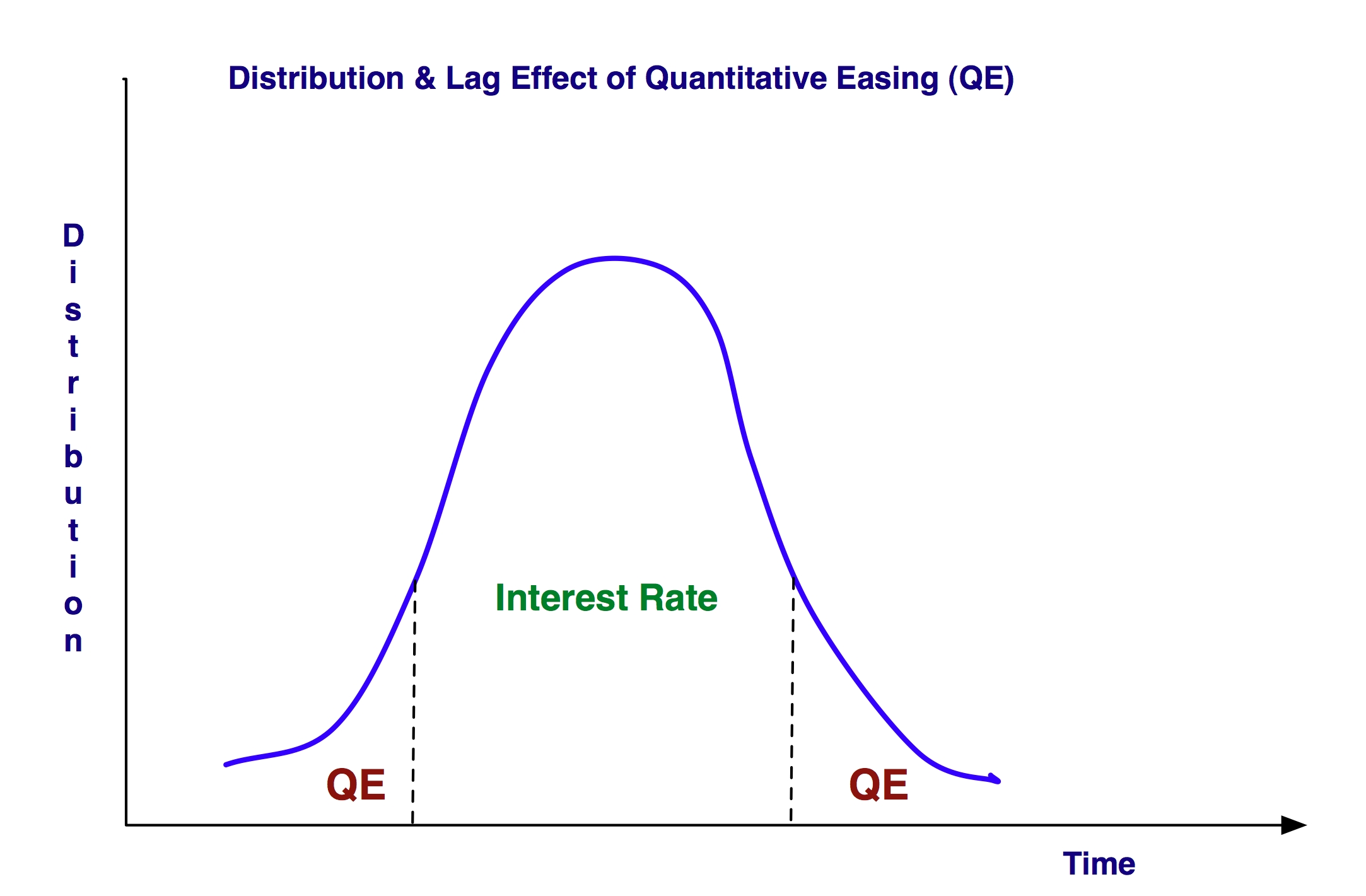
QE – Our take on the Bell Curve effect


Making sense of the distribution and lag effects
Let us explain the problem or rather challenge of choosing between Quantitative Easing (QE) and an Interest Rate reduction to stimulate economic activity, with reference to the Bell Curve diagramme above:
There are two major factors at play here:
  1. Distribution
  2. Time
With a bout of QE, the effect feeds into the margins of theBellcurve and it takes time for the distribution network (money supply chain) to filter the new enhanced supply into the economy at large.  So there is both a distribution and time lag effect with QE.

On the other hand, with an immediate Interest Rate reduction, the effect is to cover the larger middle ground of the Bellc urve more instantly.  Yes, it does depend on your wealth and debt holder structure too, but both borrowers and savers feel the effect more immediately.

But, with Interest Rates currently so low, this option is not really that feasible. With inflation running at between 2 – 5% depending on which side of the pond you are, effectively savers are paying an additional ‘tax contribution’ to the Treasury by this stealth means.

So we are back to the scenario of a tax on the stock (or wealth) of the economy, as most flows have dried up.
Therefore, join the happy queue over here.


 theMarketSoul ©2011

Monday, 19 September 2011

Recapitalising Europe


Forget about recapitalising the French Banks, saving Greece, (or the Euro)….
Euro Dominoes

Continuing our conversation on Innovation

Yes, we admit it! The headline statement above is all about grabbing your attention.  We are not advocating any disorderly default crises.

What we believe is that the ‘agricultural’ economic base and the semi-integration of Europe, via market and monetary union, without going the full circle of political and fiscal union as well, has at this point failed.

Not that a major concerted (and concentrated) effort to ensure it does not fail will end in failure itself.  But has anyone really asked the question:  At what financial cost?

 
If an US Treasury Secretary, Timothy Greitner, has to take the unprecedented step of flying across the Atlantic to come and join a European Union Finance Ministers meeting, then something big must be on the cards!
Is he going to come and tell Germany and France in person to just let Greece go?


This reminds us of a stanza from Felix Dennis’ poem “How to Get Rich” about timing:

“Good timing? To win it
You gotta be in it.
Just never be late
To quit or cut bait.

 This might just as well be the message for Europe:  How not to get Poor.  The key words are “Never be late to quit or cut bait”.

What we believe is happening behind the scenes is the planning for an orderly default mechanism and Euro ‘disbanding’.

The more Angela Merckel’s resolve hardens around saving the Euro, the less we believe Europeans themselves are warming to this concept.

 So what about Innovation then?

  
We started this article with the intention of continuing our conversation on Innovation.
So, what we mean by Recapitalising Europe actually is related to addressing the culture of decay that has enveloped Europeover the last few decades.  If Europe is referred to as the ‘Sick Man’, then there must be something behind that statement.

And we believe that it is the general lack of support for invigorating Europethat is a key driver.
What do you mean, we hear you ask?
In the quest to unite Europe, we have built a framework of a European parliament, a Council of Europe, a judicial system, etc. 

With these institutions have come regulation, rules and edicts.  Sometimes messy, sometimes helpful.  But at this juncture, we are so overrun by nonsensical regulation that the will and spirit to be creative and innovative has drained away from the general citizenry.

This is a very, very sad state of affairs.  The young European citizens have lost their ‘psychological contract’ with the wider Europe and European integration goal.  High rates of youth unemployment across Europe is breeding a generation of disengaged European citizens and ultimately is an opportunity and efficiency waste in the medium term.


But how do we Recapitalise a spirit of Innovation in Europe?

This is a key question we are going to ask of our network and as part of our general ‘outreach series’ and report back on our progress towards establishing an Innovation Framework for Recapitalising Europe.

Please ‘tune-in’ again soon for a status and progress up date.


theMarketSoul ©2011

The Market Equation


Please note:  This work is licensed under the Creative Commons Attribution-NonCommercial-ShareAlike 3.0 Unported License. To view a copy of this license, visit http://creativecommons.org/licenses/by-nc-sa/3.0/ or send a letter to Creative Commons, 444 Castro Street, Suite 900, Mountain View, California, 94041, USA.  If you would like to speak to the author about any aspect of this work, or in order to contribute towards developing the framework and ideas further, please click on the Contact Us link.  (We acknowledge and reward valued contributions).

The Market eQuation (MeQ):


Today we are commencing our investigation and outreach to discover what we will call the Market Equation.

Basically the idea is to come up with a mathematical equation and rating or ranking system to assess the state and status of various markets.

Whether this will lead to a theory of Markets that can compete with some of the other theories in existence is open to debate.

The basic premise is this:

There should be a methodology to access the Openness and Fairness of any given market versus other comparable markets.  This specific ratio or result should therefore determine the individual participant’s level of engagement and commitment to that specific market.  The result should also be able to be repeatable over time in order to elicit trends and movements of particular markets relative to each other.

The basic equation can be expressed as MA2R4K2E3T3 = OF outcome (Open & Fair).

Therefore:

OF = (A)2 x (R)4 x (K)2 x (E)3 x (T)3


And derives from the Market Equation Table listed below:

The Market Equation Table
  
OOpen
FFair
MMultiple
AAccessibleAdjoining
RRandomRapidRegularRepeatedRegulatedRisk
KComplexConnectedCompetitive
EEffectiveEfficientEquilibrium
TTechnologyTimeTrade


Key:
Subjective measure
Objective (External)  measure

MA2R4K2E3T3 = OF outcome

Therefore: OF = (A)2 x (R)4 x (K)2 x (E)3 x (T)3

The subtler reader might already have seen through this equation.  Because by dropping the M (which will always be 1) the letters that remain result in the word raket if unscrambled which in effect is:

RACKET or not?  With the additional C being the complex bit so ultimately the Market Equation becomes a COMPLEX RACKET.

theMarketSoul ©2011

Sunday, 7 August 2011

So it has finally happened. After threatening for months that a credit rating down grade was probable for the USA, Standard & Poor's finally took the 'big step' on Friday 5 August, after the major markets closed.


So what next?


In our article 'US Treasuries - Are the markets really that bothered?' published on 30 July 2011, we argued that the markets were not really bothered, as both 5 & 7 year T-Bill currently delivered a negative Real Return to investors.


Everyone is dreading the opening bells in stock capital and forex market on Monday, yet we believe the fundamental question for this week will be:


Is this an FX or market call?


What we meanby this question is:


Will the markets and market participants see the down grade as an opportunity to play an FX gain game; or has the game fundamentally shifted and will the capital markets react by demanding a higher nominal or at least Real Return on US Treasury bills?


All pointers at the moment did not indicate a problem, but time will tell on whether a fundamental shift in attitude has occurred. Remember a credit rating is only a qualitative indicator, not a quantitative one, so on a technical call a few FX traders and investors might make a profit or two; but we are all waiting to see if the entire game has changed, or not.


Other factors that might come into play soon would be QE3 and attitude hardening by major T-Bill investors.


How the US Treasury and administration now react will be crucial.


Who are we going to trust to make this big call?


theMarketSoul © 2011

Monday, 1 August 2011

A sigh of relief?


Some say that in life timing is everything...


And so too it is with economics.  We don’t yet have a fully developed and ‘mature’ [in terms of life-cycle] grasp of the impact of timing with leads and lags in the economy in general.

Yes, we have very sophisticated and advance models, analytics, knowledge management, quantitative theories, etc.; but we still do not fully comprehend the impact of time and timing in general on the factors of production influencing our ‘modern’ global economy.

In short, it looks like the potential calamitous US Debt Ceiling crisis has been averted (events during Monday 1 August still need to unfurl), meaning that the US nation can continue to settle its debt obligations for a little while longer, without President Obama having to resort to the 14th Amendment.

And this is where the timing conversation picks up its thread again.  The Debt Ceiling needs to the raised in order to settle obligations already incurred, not new spending.  Therefore, the future continues to look uncertain for the point at which ‘peak US Debt’ will be reached and how long creditor nations and other institutions will continue to fund the US appetite for amassing what seems to be an insurmountable and unsustainable level of sovereign debt.  In our previous article we discussed the negative Real US T-Bill Yields on both new 5 and 7 year US Treasuries.  If this is anything to go by, ‘peak US Debt’ must still be little while off in the distant future.

If only we could get the timing thing right and have a more insightful and meaningful (adult) debate not just in the US, but including global partners, both creditors and debtors alike.

But such is the nature of markets and spontaneous order, as espoused by our friends at the Austrian School, that we still believe and endorse the fact that ‘the market’ is still the best and most efficient mechanism for allocating resources (even financial and debt instruments) and informing the participants of potential risks and opportunities for clearing this market.

theMarketSoul ©2011

Sunday, 31 July 2011

The US Treasury Yield Curves #2 – Do you factor inflation into the deal?

In the previous article we posted, mention was made of the (0.72)% [negative 0.72%] real return US Treasury investors can currently expect on 5 Year Treasury Bills.  The Nominal (quoted) Yield Curves and Real Inflation adjusted) Yield Curves for two specific points in time, namely Friday 29 July 2011 and  30 July 2006 are listed below.


Yield Curve 1

What is interesting to note is the very flat nature of the Yield Curve for all T-Bills at the end of July 2006, at around a 5% Nominal Return for investors.  Yet the most significant fact is that the Real Yield was around 2.37% on 5 Year Treasuries, versus today’s (0.72)% on 5 Year or (0.18)% 7 Year T-Bill yields.  In order to generate a very small Real Return, you have to be looking at purchasing a 10 Year T-Bill to obtain a modest 0.38% Real Return in today’s market.

A cynic might make this remark:

“Not only do you pay your taxes, but with the negative Real Yields on both 5 & 7 Year T-Bills, you are paying the government to hold on to your cash too”

They win both ways!

theMarketSoul ©2011

Source Material:  US Treasury web site: 

Saturday, 30 July 2011

The US Treasury Yield Curves – Are the markets really that bothered?


As a general introduction today we will look at two US Treasury Yield curves.  The first Yield curve in the Curve graphic 1 below is the 3 Month bills compared to the 10 Year bills over the last 5 years.


Yield Curve 1

In this table it is clear that the current 10 Year rate of 2.82% as of 29 July 2011, is still well below the 5 year average rate.  The trend of the 3 Month bills, especially over the last few months has drifted aimlessly between 0.15% on 28 February 2011 and currently at 0.10% on 29 July 2011.  There is in fact no noticeable concern in the Bond / Capital market over the potential technical US Treasury default on 2 August 2011.

The second curve below in Curve graphic 2 illustrates this fact of the 3 Month bills trend since 28 February 2011 to 29 July 2011.  As can be observed, in the last few days a very slight spike has been observed, yet the rate at 0.10% is still below the 0.15% rate of 28 February 2011.


Yield Curve 2

In real monetary terms it is costing 5 Year Treasury bill holders (0.72%) (Yes a negative return of 0.72% currently to buy 5 Year Treasuries. (See US Treasury web site).


It will be interesting to observe and track the trends over the coming days, especially as we kick off August and Debt Ceiling D-Day in the US congress and Senate.

theMarketSoul ©2011

Source Material:  US Treasury web site: http://www.treasury.gov/resource-center/Pages/default.aspx

Thursday, 28 July 2011

Hold your nerve!


It is a confidence thing.

We are so very, very close to seeing and experiencing another colossal collapse in confidence in the world’s financial system.

This time it is driven by the ‘US Debt Ceiling impasse’.  A steady flight to gold has been taking place over the past few months and even though most informed commentators believe the  US Treasury ‘default scenario’ is not likely to physically occur, the mere threat of a default has not yet managed to ‘focus the minds’ of the US congress house of representatives locked in an ideological battle over fundamental economic policy and direction.

At stake here is a scenario that will make the 2008 financial crisis wane into insignificance, should the threat of a US Treasuries default actually play out. 

Yet, very few mainstream headlines outside of the United States have been published about this potential catastrophic event.  And we are only a few days away from the edge of disaster (Default D-Day is chalked up for Tuesday 2 August 2011) and the Washington Post has a default clock ticking down on this deadline web site.

If a default actually occurs, confidence in the international capital and currency markets will have been breached and no serious commentator has yet fully quantified or effectively mapped out the potential consequences of this potentially disastrous collapse in capital market confidence.

The only significant contribution we can make at this publication is to cross our fingers, hold as much in cash and liquid (non US dollar) assets and hope that some real focus and a meeting of minds occurs before Tuesday 2 August 2011 on Capitol Hill.

theMarketSoul ©2011