the Market Soul © 1999 - 2011 Headlines

Showing posts with label Fiscal policy. Show all posts

Thursday, 22 September 2011

QE – Our take on the Bell Curve effect


Making sense of the distribution and lag effects
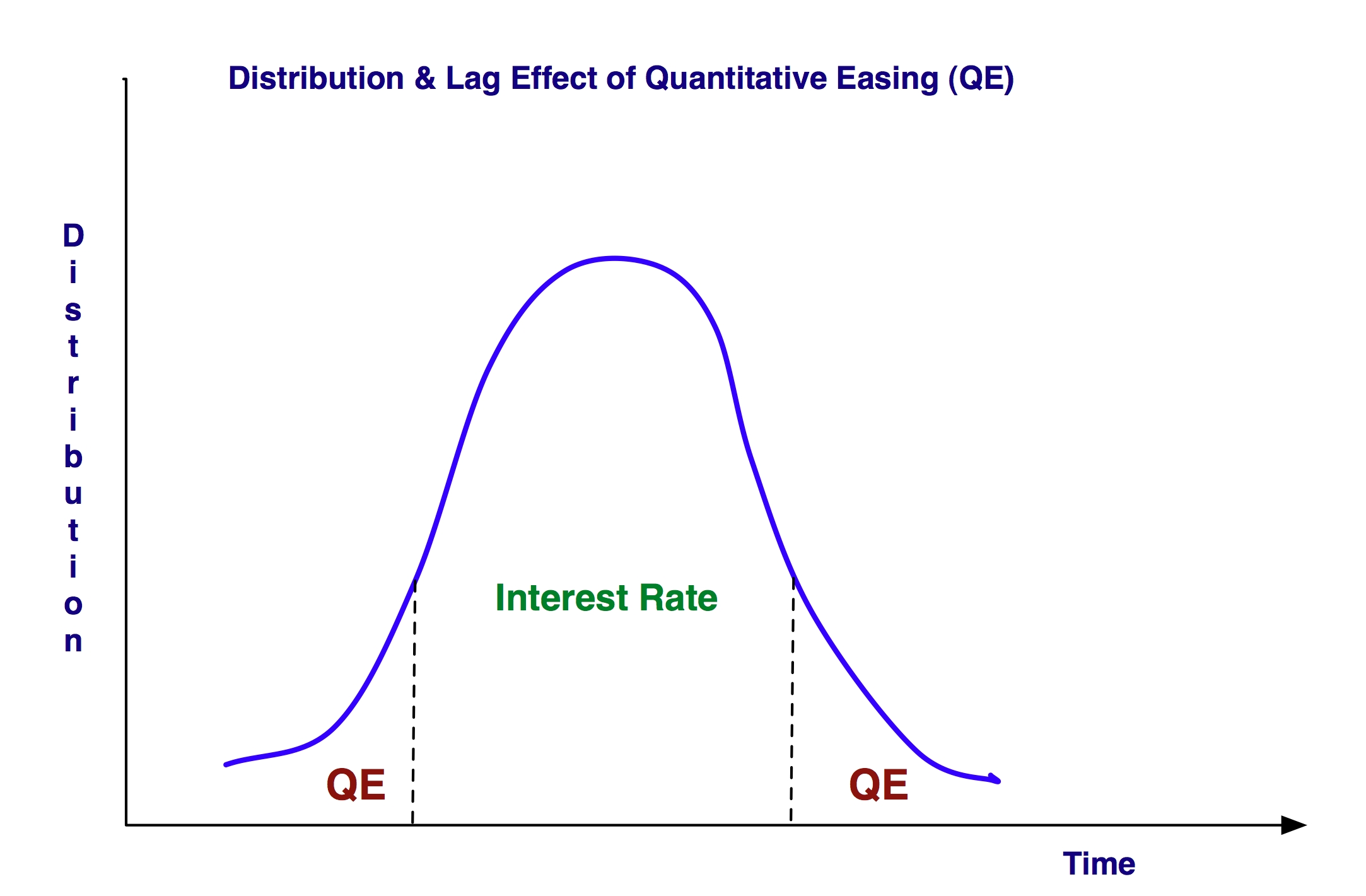
Let us explain the problem or rather challenge of choosing between Quantitative Easing (QE) and an Interest Rate reduction to stimulate economic activity, with reference to the Bell Curve diagramme above:
There are two major factors at play here:
  1. Distribution
  2. Time
With a bout of QE, the effect feeds into the margins of theBellcurve and it takes time for the distribution network (money supply chain) to filter the new enhanced supply into the economy at large.  So there is both a distribution and time lag effect with QE.

On the other hand, with an immediate Interest Rate reduction, the effect is to cover the larger middle ground of the Bellc urve more instantly.  Yes, it does depend on your wealth and debt holder structure too, but both borrowers and savers feel the effect more immediately.

But, with Interest Rates currently so low, this option is not really that feasible. With inflation running at between 2 – 5% depending on which side of the pond you are, effectively savers are paying an additional ‘tax contribution’ to the Treasury by this stealth means.

So we are back to the scenario of a tax on the stock (or wealth) of the economy, as most flows have dried up.
Therefore, join the happy queue over here.


 theMarketSoul ©2011

Sunday, 28 August 2011

Crafting the cynical generation

...continuing our conversation in the Economics of Taxation series (part 2)


A European Generation ‘E’ enquiry – (‘E’ for employment)


Referring to our previous article entitled ‘The Economics of Taxation’, today we elaborate and flesh out the basic ideas around taxation.


The basic idea is that any form of taxation becomes a drain on productive resources and at some point counter productive in attempts at balancing the government budget.  For a fuller explanation of the effects of tax rate rises see the Laffer Curve analysis and the Cato Institute’s Dan Mitchell explain the Centre for Freedom and Prosperity’s view on Fiscal policy.

 Source: Wikipedia – Laffer Curve
Two specific points are made by Dan Mitchell in his explanation, which bears thinking about:
  • We don’t necessarily want to be at the point on the curve where government revenue is maximised, due to other factors such as the disincentives of maximising tax declaration by tax payers or the cost of collecting that revenue in the first place (sub-optimisation effects)
  • Growth (in the economy) incentives fall well short on the upward side of the Laffer curve.  In plain English this means that economic growth is maximised somewhere where people have the incentive to retain as much of their hard earned income and that point is somewhere well before we reach the Government Revenue maximising point.  (The second Laffer Curve graph above captures this point in a more visual and understandable format).  At point D on the curve economic growth will be maximised and note how it still falls well short of the Government Revenue maximising point B.
The behavioural question that fascinates us at theMarketSoul ©1999 – 2011 is how come citizens in Europe are able to tolerate so much more of an overall higher tax rate burden than our cousins across the pond in the United States?

theMarketSoul ©2011


Creative Commons License
theMarketSoul ©1999 - 2011 by theMarketSoul Limited is licensed under a Creative Commons Attribution-NonCommercial-ShareAlike 3.0 Unported License.
Based on a work at themarketsoul.com.
Permissions beyond the scope of this license may be available at http://themarketsoul.com/©-copyright/.