the Market Soul © 1999 - 2011 Headlines

Showing posts with label Innovation. Show all posts

Thursday, 22 September 2011

QE – Our take on the Bell Curve effect


Making sense of the distribution and lag effects
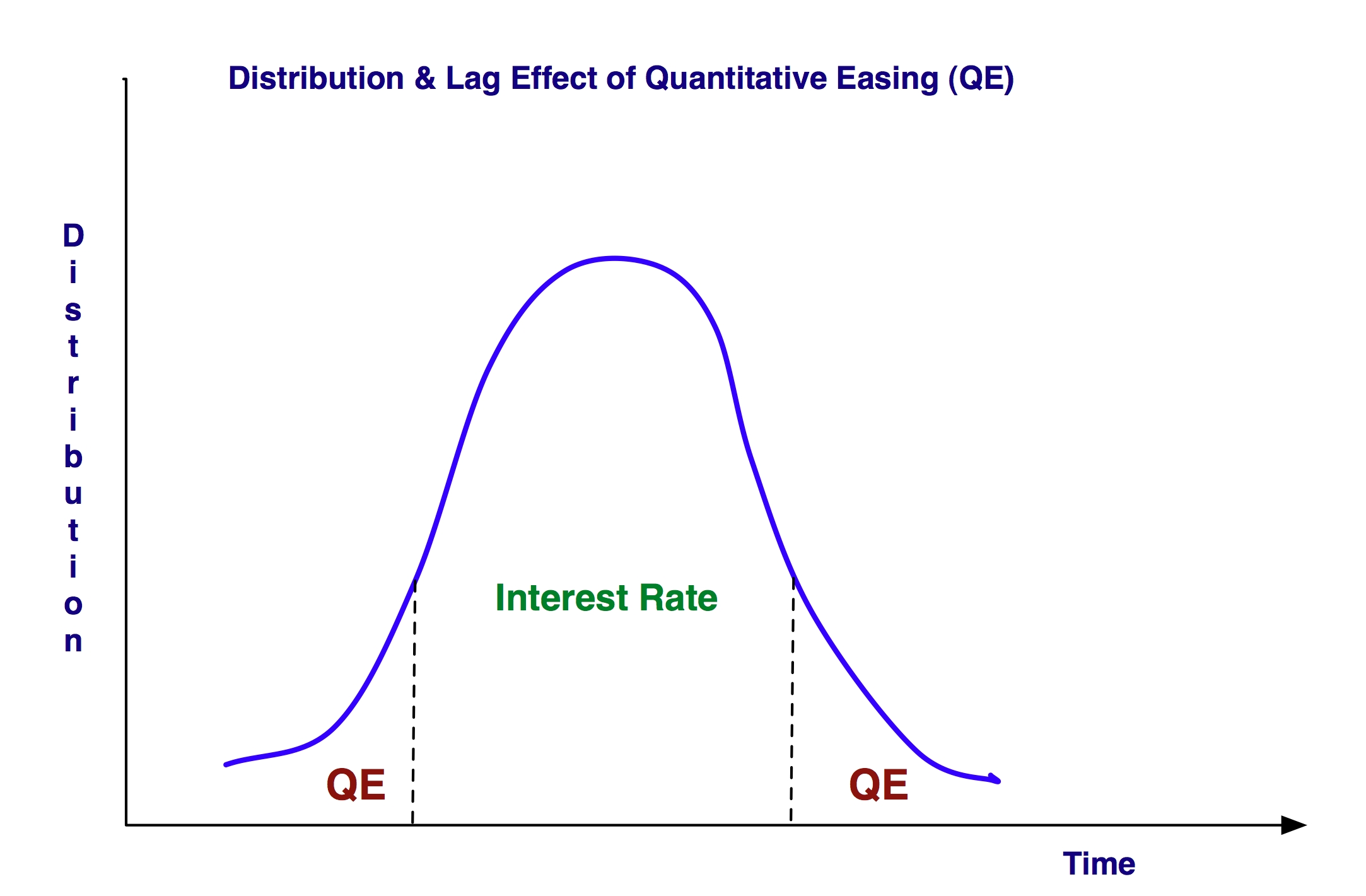
Let us explain the problem or rather challenge of choosing between Quantitative Easing (QE) and an Interest Rate reduction to stimulate economic activity, with reference to the Bell Curve diagramme above:
There are two major factors at play here:
  1. Distribution
  2. Time
With a bout of QE, the effect feeds into the margins of theBellcurve and it takes time for the distribution network (money supply chain) to filter the new enhanced supply into the economy at large.  So there is both a distribution and time lag effect with QE.

On the other hand, with an immediate Interest Rate reduction, the effect is to cover the larger middle ground of the Bellc urve more instantly.  Yes, it does depend on your wealth and debt holder structure too, but both borrowers and savers feel the effect more immediately.

But, with Interest Rates currently so low, this option is not really that feasible. With inflation running at between 2 – 5% depending on which side of the pond you are, effectively savers are paying an additional ‘tax contribution’ to the Treasury by this stealth means.

So we are back to the scenario of a tax on the stock (or wealth) of the economy, as most flows have dried up.
Therefore, join the happy queue over here.


 theMarketSoul ©2011

Monday, 19 September 2011

Recapitalising Europe


Forget about recapitalising the French Banks, saving Greece, (or the Euro)….
Euro Dominoes

Continuing our conversation on Innovation

Yes, we admit it! The headline statement above is all about grabbing your attention.  We are not advocating any disorderly default crises.

What we believe is that the ‘agricultural’ economic base and the semi-integration of Europe, via market and monetary union, without going the full circle of political and fiscal union as well, has at this point failed.

Not that a major concerted (and concentrated) effort to ensure it does not fail will end in failure itself.  But has anyone really asked the question:  At what financial cost?

 
If an US Treasury Secretary, Timothy Greitner, has to take the unprecedented step of flying across the Atlantic to come and join a European Union Finance Ministers meeting, then something big must be on the cards!
Is he going to come and tell Germany and France in person to just let Greece go?


This reminds us of a stanza from Felix Dennis’ poem “How to Get Rich” about timing:

“Good timing? To win it
You gotta be in it.
Just never be late
To quit or cut bait.

 This might just as well be the message for Europe:  How not to get Poor.  The key words are “Never be late to quit or cut bait”.

What we believe is happening behind the scenes is the planning for an orderly default mechanism and Euro ‘disbanding’.

The more Angela Merckel’s resolve hardens around saving the Euro, the less we believe Europeans themselves are warming to this concept.

 So what about Innovation then?

  
We started this article with the intention of continuing our conversation on Innovation.
So, what we mean by Recapitalising Europe actually is related to addressing the culture of decay that has enveloped Europeover the last few decades.  If Europe is referred to as the ‘Sick Man’, then there must be something behind that statement.

And we believe that it is the general lack of support for invigorating Europethat is a key driver.
What do you mean, we hear you ask?
In the quest to unite Europe, we have built a framework of a European parliament, a Council of Europe, a judicial system, etc. 

With these institutions have come regulation, rules and edicts.  Sometimes messy, sometimes helpful.  But at this juncture, we are so overrun by nonsensical regulation that the will and spirit to be creative and innovative has drained away from the general citizenry.

This is a very, very sad state of affairs.  The young European citizens have lost their ‘psychological contract’ with the wider Europe and European integration goal.  High rates of youth unemployment across Europe is breeding a generation of disengaged European citizens and ultimately is an opportunity and efficiency waste in the medium term.


But how do we Recapitalise a spirit of Innovation in Europe?

This is a key question we are going to ask of our network and as part of our general ‘outreach series’ and report back on our progress towards establishing an Innovation Framework for Recapitalising Europe.

Please ‘tune-in’ again soon for a status and progress up date.


theMarketSoul ©2011

The Market Equation


Please note:  This work is licensed under the Creative Commons Attribution-NonCommercial-ShareAlike 3.0 Unported License. To view a copy of this license, visit http://creativecommons.org/licenses/by-nc-sa/3.0/ or send a letter to Creative Commons, 444 Castro Street, Suite 900, Mountain View, California, 94041, USA.  If you would like to speak to the author about any aspect of this work, or in order to contribute towards developing the framework and ideas further, please click on the Contact Us link.  (We acknowledge and reward valued contributions).

The Market eQuation (MeQ):


Today we are commencing our investigation and outreach to discover what we will call the Market Equation.

Basically the idea is to come up with a mathematical equation and rating or ranking system to assess the state and status of various markets.

Whether this will lead to a theory of Markets that can compete with some of the other theories in existence is open to debate.

The basic premise is this:

There should be a methodology to access the Openness and Fairness of any given market versus other comparable markets.  This specific ratio or result should therefore determine the individual participant’s level of engagement and commitment to that specific market.  The result should also be able to be repeatable over time in order to elicit trends and movements of particular markets relative to each other.

The basic equation can be expressed as MA2R4K2E3T3 = OF outcome (Open & Fair).

Therefore:

OF = (A)2 x (R)4 x (K)2 x (E)3 x (T)3


And derives from the Market Equation Table listed below:

The Market Equation Table
  
OOpen
FFair
MMultiple
AAccessibleAdjoining
RRandomRapidRegularRepeatedRegulatedRisk
KComplexConnectedCompetitive
EEffectiveEfficientEquilibrium
TTechnologyTimeTrade


Key:
Subjective measure
Objective (External)  measure

MA2R4K2E3T3 = OF outcome

Therefore: OF = (A)2 x (R)4 x (K)2 x (E)3 x (T)3

The subtler reader might already have seen through this equation.  Because by dropping the M (which will always be 1) the letters that remain result in the word raket if unscrambled which in effect is:

RACKET or not?  With the additional C being the complex bit so ultimately the Market Equation becomes a COMPLEX RACKET.

theMarketSoul ©2011

Thursday, 10 June 2010

The Sustainability Gene

The focus on sustainability and sustainable practices is a self defeating objective.  Sustainability means that business leaders take their eye off the equity holder’s value creation ideal, as it flies in the face of self-interest as promoted by Adam Smith some 234 years ago (The Wealth of Nations , 1776).

Self-interest and the pursuit therefore is being clouded by a multitude of other non value adding factors that is diluting the message and contributing to more uncertainty and risk and therefore capital flight and volatility in the financial and capital markets as we have experienced over the last 2 years.

This process and Zeitgeist will not disappear or be properly understood, unless we develop a deeper understanding and familiarity with uncertainty as a driver of the innovative spirit of human endeavour.


Risk management per se is not the answer and panacea it is held out to be, and if it promotes a more risk-averse society, then we are heading for the middle ground of mediocrity, tyranny and decline in social values and structures that have taken many hundreds of years to create.

Being part of the system with a myopic view, rather than standing outside the system with a holistic and reflective frame of mind is causing more damage than good.
Yet how are we to live and deal with the cognitive dissonance that these two views by the very nature induce?

Let’s open up to good honest debate, search and reflection, rather than to dogma and a narrow focus on defending vested interests and old world models.

We are in the midst of a major cultural, economic and world order paradigm shift and the outcome is uncertain, potentially destabilising, but we must embrace this exploration of uncertainty and chaos the will inevitably ensue.

theMarketSoul ©2010

Thursday, 20 May 2010

The Sustainability Gene


The CBI published a report entitled "The shape of business - the next ten years" in late 2009.

The authors identified 5 key drivers affecting the business environment, namely:

1.  Changing finance and capital conditions,
2.  The decline of trust in business and markets,
3.  A less benign macroeconomic environment,
4.  Social and demographic change where the recession will have a major influence,
5.  Sustainability and resource issue.

We pick up our cue from the fifth driver being Sustainability for today's post.

Our comment serves more as an aide-mémoire to return to in more detail in future articles.  This post also does not serve as a commentary on the CBI's report, but rather as a general opinion on the nature of sustainability and human a nature and is therefore pure conjecture.

We believe that sustainability as understood to mean the impact we have on the planet and the resources we consume, is not a natural human phenomenon, in the face of self-interest (as per the economic definition of the term) and competition for scarce resources.

In other words sustainability flies in the face of human kind's natural tendencies to compete for resources, either by war and confiscation, or by trade and exchange for those scarce resources.

We therefore contend that as human actors interacting with and through the free market mechanism, we do not naturally possess a 'sustainability gene', but instead have to develop a new model and framework for ensuring that this objective is effectively pursued and becomes part of the underlying psyche of being in business and discharging our fiduciary responsibilities.

Linking to our previous post ‘The Markets do not need certainty’, we contend that it is structure that helps shape markets and creates the conditions conducive to the effective operation of those markets.  Other factors will ultimately affect the efficiency of the markets and some of these factors include Innovation and such like.

In conclusion, let us wrap up with a few quotes on sustainability:
·         You can never have an impact on society if you have not changed yourself.  Nelson Mandela
·         The very process of the restoring the land to health is the process through which we become attuned to Nature and, through Nature, with ourselves.  Chris Maser
·         We can learn whatever we need in nature because we are part of nature.  Human beings are part of Creation.  We live by the same laws as all of nature.  Anne Wilson Schaef
And in the final quote above we possibly see a glimmer of hope for a possible answer to our ‘Sustainability Gene’ deficiency.  Somehow Adam Smith’s ‘self interest’ and the modern free(ish) market system require an injection of nature law and justice. 

Whatever that shall be.

Friday, 14 May 2010

End to End or Integrated systems and thinking processes

Silos. 

We hear this management buzz word quite often touted in office settings, and conferences in the media, etc.

We argue today that silos are cultural norms.  They are national cultural models possibly endemic of certain national cultures.  We certainly have no empirical evidence for this, so this is pure opinion and conjecture on the part of theMarketSoul contributors.
In our previous article titled Increased Friction Costs we briefly touched on the issue of processes being back to front in Britain.  Processes are very much driven by the national ‘Carrot & Stick’ approach, rather than an enablement, ‘build and they will come’ approach where solutions are found and embedded then suitable and profitable markets are found for those solutions.

Now we can argue that in a very narrowly defined risk management culture and faced with the reality of reduced opportunity to obtain and procure financing to ‘build solutions on speculation’, we just cannot afford to change our exiting disastrous management and control processes.

But this is exactly where we have to stop the train as quickly as possible and change direction to ‘climb the hill ahead’ so that we can experience the potential and opportunity to ‘see the view from another mountain top vantage spot’…
We are in a tight spot.  That is a fact.  However, we are being held to ransom at the moment by a ‘political’ system and governing party trying to string out the last days of their tenure in power.  [This article was initially written before the General Election in Britain].

There is hope, there is a sliver of light and opportunity on the horizon.  However, we will need to learn to deal with some pain, as we readjust the ‘crowding out’ of growth by the public sector and debt burden.  However, we need to recognise that we will have to apply a bit more ‘market discipline’ to finding, scoping, building and implementing solutions to our problems.

Small and localism are in fact parts of (but not the entire) solution, where small providers (entrepreneurs) are incentivised and tasked with coming together to experiment and create solutions, that hopefully mitigates the risk of large scale failure, but at the same time find scalable solutions that can rapidly be deployed to solve some of the challenges we currently face.

In IT deployment and development projects they call this kind of rapid, ‘low hanging fruits’ approach to development work Agile Development or AD for short.  Maybe this together with the professional service chains and clustering we will touch on in subsequent articles is the way forward.

theMarketSoul © 2010

Our Change Process methodology.  Click the link.

Wednesday, 17 March 2010

The Trouble with Innovation – Part 5

As CeBIT 2010 ended this series of articles will move forward from the baseline discussed do far.
In the last article Part 4 we alluded to Risk and the positive Risk Management strategy of Value Based Principles.  In order to conclude the next two steps into Value Creation Chain, we need to focus on ‘Value Management’ and ‘Value Measurement’.
Firstly then, value management:


Managing the Value


We highlighted the seven Value Drivers in the previous article and below we elaborate on what lies behind the logic of each:


1. Sale Growth Rate


As the starting point profit and growth planning must set a solid platform to help drive the organisation forward.  Whether the approach is to focus on product or market development, or a combination of both, we help identify the resource allocation pressure and decision points, in order to maximise the return on effort invested.
As a top line focus point Sales Growth helps galvanise the organisational management and employees to identify suitable market opportunities to pursue to overall sales or set-off objectives.


2. Operating Margin


Operating margin becomes the focal point for operational efficiency and cost management strategies.  During the recession most organisations have looked long and hard at this particular area, partly because sales growth have suffered quite severely, but also  because they have realised that in any growth cycle such as we experienced between 2003 – 2007, ‘organisational operational  padding’  have added unwarranted inefficiencies to their operating processes.
The conundrum at the moment facing most organisations is the question of how to drive sales forward and upward, with the reduced operational cost base in place.  The two major levers of Sales Growth and Operational Cost need to be manipulated with the utmost delicacy and ‘a very steady hand on the tiller’.


3. Cash Tax Rates


It is a given that the focus of most western governments will be on maximising Treasury tax takes over the next few years, in order to manage the huge fiscal stimulus packages introduced to support the economies.  We expect quite a militant and aggressive approach in this area and a deluge of mitigation and profit extraction strategies to drive this ‘opportunity cost’ of business (your licence to operate fee) down.  This is an area best left to the specialist is the area, however, it is still a value investment of your time to keep a beady eye on this ‘hidden value driver’.


4. Fixed Capital Investment


Financing and timing are the two major factors to consider in Fixed Capital Investment area of your business.  A creative off balance sheet financing strategy might assist in extracting value in this area; however, the key issue is to have the capital infrastructure in place to support your organisational objectives.  Taking advantage of distressed assets values might will set up and gear the organisation towards supporting the initial Sales Growth driver.


5. Working Capital Investment


Liquidity and liquidity risk management are the key focus areas in maximising value in your working capital management processes.


6. Cost of Capital


A one-off opportunity to positively manage the organisational cost of capital down has emerged at the end of this recessionary cycle; however, it is up to the astute organisational leadership to take advantage of the opportunity.  We recognise that a multitude of factors currently exist which might make taking advantage of this unique opportunity quite challenging, however, if the platform and measurement dashboards, combined with the organisational structure and resources are in place to take advantage of the historically low cost of capital rates, we encourage every organisation to take advantage of this potential opportunity.


7. Planning horizon


Clearly understanding that a longer term timeframe is genuinely beneficial, combined with regulatory factors encouraging the long view at the moment, will help the organisational leadership grasp both drivers of value in this factor, namely the current departure point and value calculation and the ultimate exist strategy value or Terminal Value of the organisation.


Measuring the Value


Graphical Key Performance and Risk Indicators combined with Short Interval Cycles (SICs) focus management effort on taking corrective action very quickly.  The unique pro-active dashboards help turn around the reactive Management Information Systems and becomes a vital and integral part of the overall strategic management philosophy underpinning the Risk Based Value Management practice be have developed.
In the next article we will focus on measuring the value in more detail and on Entropy, an article posted by a fellow blogger at Cheap Seats.  We will draw our inspiration from those thoughts.


theMarketSoul ©2010

Monday, 15 March 2010

The trouble with Innovation – Part 4

Risk! This will be the main theme of this part of the series we are investigating. As highlighted in part 3 Risk Management and Sustainability are key factors to consider in unleashing Innovation and creativity in the organisation’s life cycle.


However, in the word life-cycle we already have a clue as to the inevitability of decline and ultimately the death of the enterprise, per se.

In the current climate, Risk Management has a pure Compliance and Regulatory connotation.

We assert that there are two sides to the Risk Management coin:


A Negative and Positive approach to Risk Management. In the negative worldview, risk is associated with mitigating and loss prevention strategies, namely compliance and regulatory requirements in addition to downside risk alleviation.

A Positive Risk Management framework would look to the up side and Value Creation potential of enterprise governance frameworks.

The overall philosophy and practical application of the model is embodied in a sound risk management framework underpin by the convergence of Internal Auditing and Financial Controls and the Value drivers inherent in the Value Based Management approach, namely


(1) Creating Value


(2) Managing Value


(3) Measuring the Value created


The focus in measuring and managing for value and thus superior organisational performance is encapsulated in performance and investment drivers such as:


a. Sales Growth


b. Operating Margin


c. Cash Tax rates


d. Fixed Capital Investment


e. Working Capital Investment


f. Cost of Capital


g. The Planning Period


Creating Value


The departure point in creating value ultimately has to have Innovation as one of the factor inputs required to create Economic Value in any organisation. This in combination with other economic factor inputs such as capital, land and labour are the foundation building blocks of any organisational sustainable growth approach.


Therefore, combining resource inputs such as capital and labour with innovation, in the right mix and during the right time frame are the sustained growth drivers in any organisation.


In the next article in this series we will address the next step in the Value Based Management framework, namely ‘Managing Value’ and the further step of ‘Measuring Value’.


theMarketSoul ©2010