the Market Soul © 1999 - 2011 Headlines

Showing posts with label Governance. Show all posts

Thursday, 22 September 2011

QE – Our take on the Bell Curve effect


Making sense of the distribution and lag effects
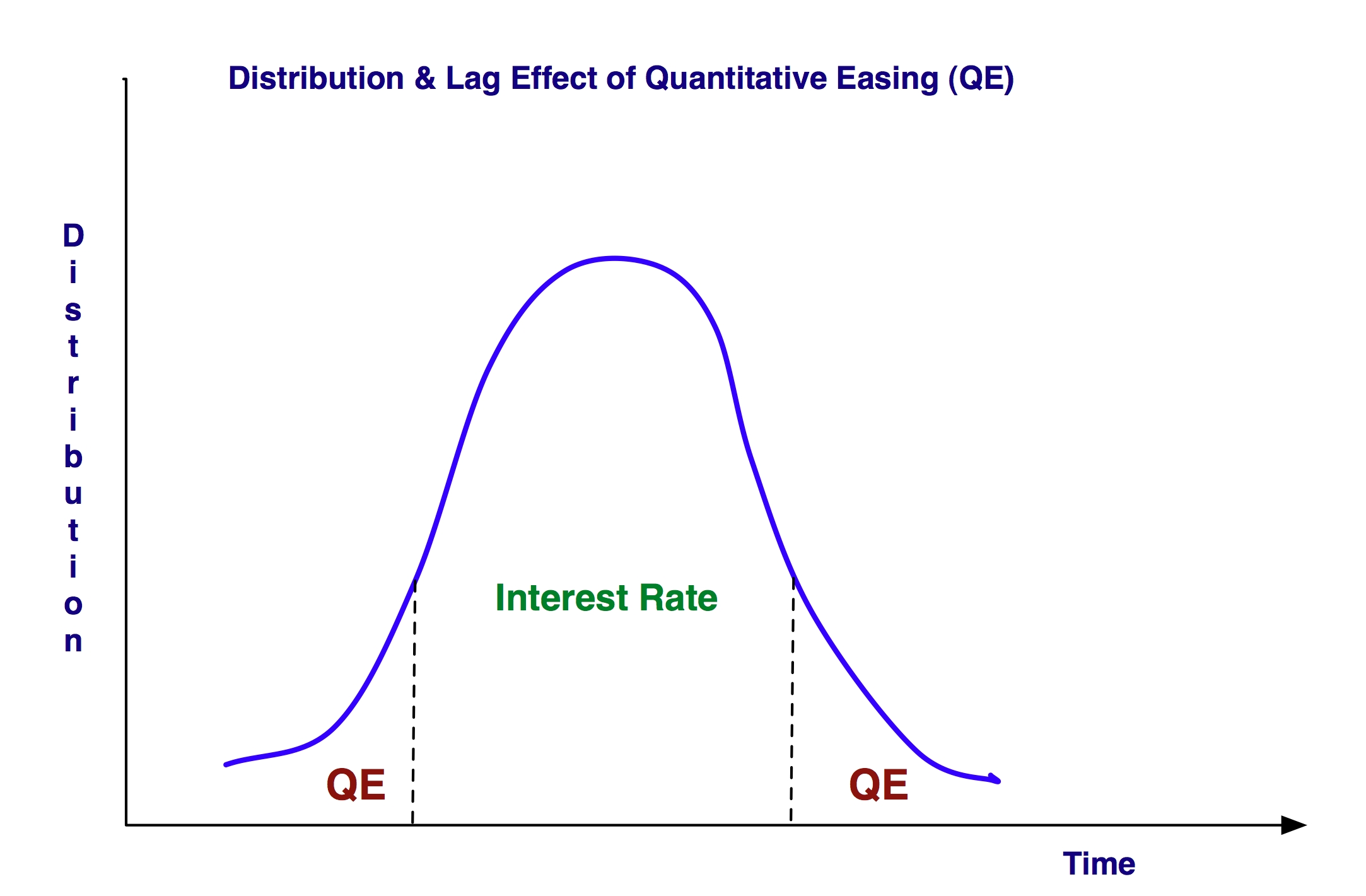
Let us explain the problem or rather challenge of choosing between Quantitative Easing (QE) and an Interest Rate reduction to stimulate economic activity, with reference to the Bell Curve diagramme above:
There are two major factors at play here:
  1. Distribution
  2. Time
With a bout of QE, the effect feeds into the margins of theBellcurve and it takes time for the distribution network (money supply chain) to filter the new enhanced supply into the economy at large.  So there is both a distribution and time lag effect with QE.

On the other hand, with an immediate Interest Rate reduction, the effect is to cover the larger middle ground of the Bellc urve more instantly.  Yes, it does depend on your wealth and debt holder structure too, but both borrowers and savers feel the effect more immediately.

But, with Interest Rates currently so low, this option is not really that feasible. With inflation running at between 2 – 5% depending on which side of the pond you are, effectively savers are paying an additional ‘tax contribution’ to the Treasury by this stealth means.

So we are back to the scenario of a tax on the stock (or wealth) of the economy, as most flows have dried up.
Therefore, join the happy queue over here.


 theMarketSoul ©2011

Tuesday, 16 August 2011

The Economics of Social breakdown


How do we define the state of our nation at the moment?
For a little while now we have been experiencing an ‘unease’ with the communication revolution and the disparate nature of communication tools at our disposal. On the surface it would appear that what is happening is that rather than bind together a society it is having exactly the opposite effect.
The recent riots in the UK is just a small manifestation of this general unease.
From a purely economic and dispassionate analysis of the situation, we would offer the following opinion:
We don’t have a ‘broken society‘, as is such an often uttered phrase, but rather a complete misunderstanding of the disconnect between our ‘old / slow business models’ and the pace at which technology moves and changes the rules of engagement.
The pace of change in organisational design, planning and execution models lags multiple-fold behind the pace of technological advancement. It almost has an exponential relationship and due to this factor, we have not yet come to grips with applying new technology to ‘old world’ thinking, with its checks and balances and control mechanisms.
The disconnect between the pace of the communication revolution and the nature of diminishing returns has led to a massive gap in appreciating the fact the occasionally we have to pause and reflect on where we are and where we want to be.
Both the continuing economic crisis, pace of change, realisation that the future does not hold the same promise and prosperity as the recent past; are all infliction points that have amplified and spilled over into anger and the violence of the past few days.
So what we have is a ‘broken understanding’ of how different factors of production, such as land, labour, capital, enterprise and innovation has drifted further apart and caused unnecessary and unsustainable concentrations of accumulated power and risk amongst differing population groupings in the UK and elsewhere.
Remember, all five of these factors of production listed above need to work in harmony, in order to add, create and manage value and output that are useful and life sustaining necessities for all citizens.
Let’s address the gap between political and civil society to ensure sustainable progress and development for all.


Saturday, 30 July 2011

The US Treasury Yield Curves – Are the markets really that bothered?


As a general introduction today we will look at two US Treasury Yield curves.  The first Yield curve in the Curve graphic 1 below is the 3 Month bills compared to the 10 Year bills over the last 5 years.


Yield Curve 1

In this table it is clear that the current 10 Year rate of 2.82% as of 29 July 2011, is still well below the 5 year average rate.  The trend of the 3 Month bills, especially over the last few months has drifted aimlessly between 0.15% on 28 February 2011 and currently at 0.10% on 29 July 2011.  There is in fact no noticeable concern in the Bond / Capital market over the potential technical US Treasury default on 2 August 2011.

The second curve below in Curve graphic 2 illustrates this fact of the 3 Month bills trend since 28 February 2011 to 29 July 2011.  As can be observed, in the last few days a very slight spike has been observed, yet the rate at 0.10% is still below the 0.15% rate of 28 February 2011.


Yield Curve 2

In real monetary terms it is costing 5 Year Treasury bill holders (0.72%) (Yes a negative return of 0.72% currently to buy 5 Year Treasuries. (See US Treasury web site).


It will be interesting to observe and track the trends over the coming days, especially as we kick off August and Debt Ceiling D-Day in the US congress and Senate.

theMarketSoul ©2011

Source Material:  US Treasury web site: http://www.treasury.gov/resource-center/Pages/default.aspx

Thursday, 28 July 2011

Hold your nerve!


It is a confidence thing.

We are so very, very close to seeing and experiencing another colossal collapse in confidence in the world’s financial system.

This time it is driven by the ‘US Debt Ceiling impasse’.  A steady flight to gold has been taking place over the past few months and even though most informed commentators believe the  US Treasury ‘default scenario’ is not likely to physically occur, the mere threat of a default has not yet managed to ‘focus the minds’ of the US congress house of representatives locked in an ideological battle over fundamental economic policy and direction.

At stake here is a scenario that will make the 2008 financial crisis wane into insignificance, should the threat of a US Treasuries default actually play out. 

Yet, very few mainstream headlines outside of the United States have been published about this potential catastrophic event.  And we are only a few days away from the edge of disaster (Default D-Day is chalked up for Tuesday 2 August 2011) and the Washington Post has a default clock ticking down on this deadline web site.

If a default actually occurs, confidence in the international capital and currency markets will have been breached and no serious commentator has yet fully quantified or effectively mapped out the potential consequences of this potentially disastrous collapse in capital market confidence.

The only significant contribution we can make at this publication is to cross our fingers, hold as much in cash and liquid (non US dollar) assets and hope that some real focus and a meeting of minds occurs before Tuesday 2 August 2011 on Capitol Hill.

theMarketSoul ©2011